

Your Digital Gold Rush: How to Start a Profitable WIFI Business in Mzansi
In today’s hyper-connected world, internet access is no longer a luxury; it’s a necessity. Schoolchildren need affordable, reliable connectivity for doing homework. Street vendors require it for processing SnapScan payments. The demand for such connectivity in South Africa is stronger than ever. And right at the heart of this digital revolution lies a golden opportunity: the WIFI business.
Launching a Wi-Fi business in South Africa could be your ticket to financial independence. It doesn’t matter if you are in Soweto, Durban, Gqeberha, or a quiet township in Limpopo. It can also provide a chance for community impact and tech entrepreneurship.
But how exactly do you turn this idea into a profitable, legal, and scalable venture? This in-depth guide is crafted from two decades of mentoring startups across Mzansi. We’ll unpack everything you need to know to kickstart your WiFi business. We aim to ensure you don’t get lost in jargon, red tape, or outdated advice.
Why a WiFi Business in Mzansi Makes Sense Right Now
Let’s be real: South Africa’s data prices have long been a sore point. Despite improvements over the past five years, many households and small businesses still pay more for less. This is true when compared to global benchmarks. Over 63% of South Africans rely on mobile data for internet access. The ICASA 2025 Sector Performance Report reveals this. They depend on mobile data as their primary source. This is not because it’s better, but because fixed broadband remains out of reach in many areas.

This gap is where the WIFI business in Mzansi thrives. Imagine providing stable, uncapped internet to neighbours, spaza shops, hair salons, or taxi ranks. It’s offered at half the cost of their mobile bundles. Suddenly, you’re not just selling connectivity; you’re enabling digital inclusion.
Your reputation hinges on uptime and response time. Include a simple WhatsApp or Telegram line; your business WIFI phone doesn’t need to be a call centre, just reliable.
And let’s not forget the youth economy. Universities like TUT and UJ see thousands of students hunting for cheap, fast Wi-Fi every semester. In townships like Khayelitsha or Alexandra, “Wi-Fi shacks” are already booming. All of this reveals one truth. The market is hungry. The timing has never been better to launch your WiFi business.
Understanding the Legal and Regulatory Landscape
Before you buy your first router or sign up with a backbone provider, you must navigate South Africa’s telecom regulations. The Independent Communications Authority of South Africa (ICAS) oversees internet service provision. You don’t always need a full Electronic Communications Service (ECS) licence for small-scale resale. However, if you’re installing physical infrastructure, you do need to register as an Electronic Communications Network Service (ECNS) provider.
Thankfully, many new entrepreneurs start by partnering with licensed ISPs. They choose companies like MTN Wi-Fi Business, Vodacom Wi-Fi Business, Telkom Wi-Fi Business, or RAIN Wi-Fi Business. These companies allow you to resell their fibre or wireless backhaul under your own brand, a model known as “white-labelling”. This keeps your startup costs low while ensuring compliance.
Pro tip: Always get written confirmation from your upstream provider about what you’re allowed to resell. Avoid grey-market SIM farms. Do not engage in unlicensed spectrum use. Authorities are cracking down hard. One raid could wipe out your entire operation.
Crafting a Realistic WiFi Business Plan
A solid WiFi business plan isn’t just for investors; it’s your personal roadmap. Start by answering three critical questions:
- Who exactly will I serve? (e.g., students in a student hostel, informal traders at a taxi rank, or a block of flats in Hillbrow)
- What speeds and data caps will I offer and at what price?
- How will I differentiate from giants like Vumatel Fibre Wi-Fi Business or Openserve Wi-Fi Business?
Your plan should include a cash flow projection. Most small-scale WIFI business setups cost between R8,000 and R25,000 to launch. This amount covers a quality business-grade router like a MikroTik or Ubiquiti. It also includes mounting hardware, cabling, and your first month’s backhaul subscription. If you’re targeting a WIFI business in Kasi, consider solar-powered setups to bypass load-shedding.
Don’t forget customer support. In the WIFI selling business, your reputation hinges on uptime and response time. Include a simple WhatsApp or Telegram line; your business WIFI phone doesn’t need to be a call centre, just reliable.
Choosing Your Tech Stack: Beyond the Basic Router
Not all routers are created equal. For a Wi-Fi hotspot business, you need gear that handles dozens (or hundreds) of concurrent users without melting down. Consumer routers from Checkers or Game won’t cut it.
Invest in enterprise-grade equipment:
- MikroTik hAP series: Affordable, powerful, and allows bandwidth throttling per user.
- Ubiquiti UniFi: Great for multi-building setups, with cloud management.
- TP-Link Omada: Budget-friendly but scalable for small clusters.
Pair this with a reliable backhaul. Vox uncapped Wi-Fi packages are popular for urban setups. Wireless ISPs using WISPs (Wireless Internet Service Providers) may suit rural areas. If you’re near fibre infrastructure, Vox Internet or Openserve resellers offer stable, high-capacity pipes.

Crucially, segment your network. Never let paying customers share the same SSID as your admin devices. Use VLANs or separate access points to prevent abuse and guarantee security.
Regulatory Landscape: ICASA Licensing
Before you connect your first customer, you need to navigate the regulatory environment. The Independent Communications Authority of South Africa (ICASA) is the body that governs the communications industry. Simply put, any business carrying communications from one point to another needs a licence.
Electronic Communications Service (ECS) Licence
If you choose the reseller model (Choice 1), you will primarily need an ECS licence. This applies to Internet Service Providers. They rely on another company’s network. Yet, they own some hardware, like the customer’s wifi router for business. This licence is essential for legally providing the service.
Electronic Communications Network Service (ECNS) Licence
If you decide to build and run your own physical network (Choice 2), you need an ECNS licence. This is true even for a small, localised wireless network.
- Class ECNS (C-ECNS): This is for operators focused on a smaller area. Examples include a single district or local municipality. This is a far more attainable goal than a national licence.
- Individual ECNS (I-ECNS): This is for national or provincial networks, and it is a significantly more complex and expensive undertaking.
It is critically important to understand that compliance is non-negotiable. ICASA requires various annual submissions, and your licence fees are calculated based on your overall revenue. Many new entrepreneurs underestimate this administrative load, but it is the backbone of a legal, sustainable WiFi business in Mzansi. You must make sure all the equipment you use is ICASA type-approved. This includes the access points, the core switches, and the customer premises equipment.
Pricing Models That Actually Work
Pricing is where many WiFi business ventures stumble. Charge too little, and you can’t cover costs. Charge too much, and customers stick with Free Basics or expensive mobile data.
Popular models across Mzansi include:
- Piso Wi-Fi Business: Inspired by the Philippines, users pay per minute via coins, tokens, or mobile money. Great for foot traffic areas.
- Daily/Weekly Bundles: R5 for 1 hour. R20 for a day. R100 for a week. It is simple, transparent, and cash-friendly.
- Subscription Plans: R250/month for 10Mbps uncapped, ideal for flats or student digs.
Always test pricing in your specific area. In Sandton, R150/week will fly. In Diepsloot, R30 might be the ceiling. Flexibility is key.
Marketing Your WiFi Business Without Breaking the Bank
You don’t need a TV ad to fill your Wi-Fi spots. Start hyper-local:
- Print flyers in Xhosa, Zulu, and English.
- Partner with spaza shops; they’ll promote your service if they get free access.
- Use TikTok and Instagram Reels to show speed tests and happy customers (“Look how fast this is – just R10 for an hour!”).
Google My Business is essential. When someone searches “Wi-Fi for business near me”, you want your hotspot to pop up first. Encourage users to leave reviews; social proof builds trust faster than any billboard.
Scaling: From One Hotspot to a Local Empire
Once your first site breaks even (usually within 2–4 months), consider expansion. Maybe you add a second location or bundle in printing or phone charging. Some entrepreneurs even pivot into urban Wi-Fi business class, offering premium, password-protected networks for remote workers or gamers.
Look into partnerships. Municipalities like eThekwini and Cape Town are piloting public Wi-Fi projects and often subcontract local operators. Being registered as a B-BBEE compliant business gives you an edge here.
And never underestimate data insights. Track peak usage times, most visited sites, and dropout rates. This helps you tweak plans. It helps you upgrade capacity. You can even sell anonymised trend reports to local businesses. This is another revenue stream from your WIFI business.
Navigating Challenges: Load-Shedding, Vandalism, and Competition
Let’s not sugarcoat it. Running a WiFi business in South Africa comes with risks. Load-shedding can knock you offline for hours. Invest in a small inverter (R2,000–R5,000) or UPS to keep critical gear running.
Vandalism and cable theft are real in some areas. Install cameras, mount gear high, and build relationships with local security forums. Sometimes, community buy-in is your best protection.
In townships like Khayelitsha or Alexandra, “Wi-Fi shacks” are already booming. All of this reveals one truth. The market is hungry. The timing has never been better to launch your WiFi business.
As for competition? Big telcos won’t chase R20 customers, but other micro-ISPs might. That’s why service matters more than speed. A friendly face, quick fixes, and flexible payment options will keep clients loyal even if MTN launches a cheaper plan.
The Future: Beyond Basic Connectivity
The WIFI business isn’t static. Forward-thinking Mzansi entrepreneurs are layering services:
- Wi-Fi + security cameras for landlords
- Wi-Fi + digital literacy workshops for elders
- Wi-Fi + local content portals (think: community news, job boards, local deals)
Imagine your local business-class Wi-Fi network offering exclusive access to job listings or school resources. You’re no longer just an ISP; you’re a digital hub.
5G is rolling out, and satellite internet (like Starlink) is entering the market. Even remote areas will soon have more options. The key? Stay agile, listen to your users, and never stop improving.
Final Thoughts: Your Time Is Now
Starting a Wi-Fi business in South Africa isn’t about being a tech genius. It’s about solving a real problem for real people. The goal is affordable and reliable internet. This is critical in a country where data poverty still holds back millions.
With a clear Wi-Fi business plan, the right partnerships (MTN Wi-Fi Business, Telkom Wi-Fi Business, RAIN Wi-Fi Business, etc.), and a community-first mindset, you can build something that’s not just profitable but purposeful.
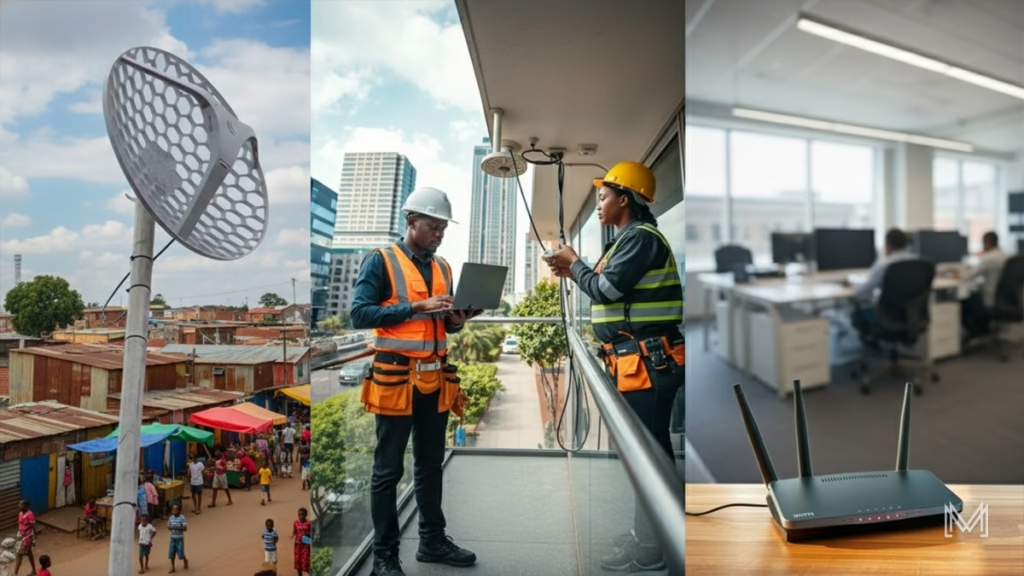
So don’t wait for “someday”. Grab a notebook, scout your first location, and take that first step. Mzansi’s digital future isn’t just being built by big corporations. People like you are wiring it, one router at a time.
Because in the end, every great WiFi business starts with a single connection.
FAQ’s Start WiFi Business South Africa
Do I need a licence to start a small WiFi resale business in South Africa?
For a small-scale resale model, you will primarily need an Electronic Communications Service (ECS) licence from ICASA. If you plan to install your own physical network infrastructure, the process becomes more complex. You will need an Electronic Communications Network Service (ECNS) licence.
How much money do I generally need to start a basic WiFi hotspot business?
Most small-scale WiFi business setups can be launched with between R8,000 and R25,000. This covers essential business-grade gear like a router, mounting hardware, and the first month of your backhaul subscription.
What kind of router should I buy for a community WiFi hotspot?
You must invest in enterprise-grade equipment like MikroTik or Ubiquiti, as consumer routers won’t handle many users. These devices allow you to manage bandwidth effectively and guarantee stable service for paying customers.
How can I protect my WiFi business from load-shedding during power cuts?
Investing in a small inverter is wise. A reliable UPS will also keep your critical networking gear running smoothly. This ensures your service stays online while customers relying on your WiFi cannot use their own power.
What is the best way to market my new WiFi service locally?
Start hyper-local by printing flyers in local languages and partnering with nearby spaza shops for promotion. Also, use social media like TikTok to show speed tests and encourage happy customers to leave good Google reviews.


